
- Ref # CAB00011
- November 22, 2020
Unanimous Jury Verdicts
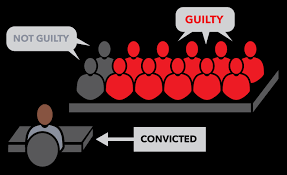
The United States Supreme Court, overruling earlier authority to the contrary (see Apodaca v. Oregon (1972) 406 U.S. 404, and Johnson v. Louisiana (1972) 406 U.S. 356.), held late last month in a seriously fractured, split (6-to3) decision, that jury verdicts in “serious” cases must be unanimous. (Ramos v. Louisiana (Apr. 20, 2020) __ U.S. __ [__ S.Ct. __; __ L.Ed.2nd __; 2020 U.S. LEXIS 2407].) Both Oregon and Louisiana allowed for 10-to-2 convictions in criminal cases (although I read elsewhere that Louisiana has already changed its law on this issue, via a state constitutional amendment, a couple of years ago). The Sixth Amendment, applicable to the states via the Fourteenth Amendment’s due process clause, provides that “(i)n all criminal prosecutions, the accused shall enjoy the right to a speedy and public trial, by an impartial jury.” While the Constitution does not specifically say that jury verdicts must be unanimous, the Supreme Court, tracing the intent of the Sixth Amendment back to early Common law, now holds that at least in felony trials, the Sixth Amendment is to be interpreted to require a unanimous jury verdict. California, of course, already requires unanimous jury verdicts for all offenses, misdemeanor and felony (see Cal. Const., Art. 1, § 16), so we’re not affected. Note also that the Ramos decision only affects felony verdicts, and then only for those cases not yet final on appeal. Still, Oregon and Louisiana are both going to have to retry a whole bunch of felony cases, estimated to be about 100, in Louisiana.
© 2026 Legal Updates, LLC.
This content is protected by copyright law. Republishing or redistribution in any form without written permission is strictly prohibited. For licensing or reprint requests, contact support@legalupdates.com.