
- Ref # CAC10042
- April 06, 2025
The Necessity Defense: Choosing Between the Lesser of Two Evils Is Not as Simple as You Might Think
Rule: The “necessity defense” involves the situation where a criminal defendant’s illegal conduct is the lesser of two evils, justifying the defendant’s criminal acts taken to avert a greater harm. For the necessity defense to apply, a defendant must prove by a preponderance of the evidence, as viewed objectively, that (1) he was faced with a choice of evils and chose the lesser evil, (2) he acted to prevent imminent harm, (3) he reasonably anticipated a causal relation between his conduct and the harm to be avoided and (4) there were no other legal alternatives to violating the law.
Facts: Defendant Philip A. Powers III fancied himself a great outdoorsman. To prove it, he set out by himself on a “very hot and dry” day in May 2018, to begin a 19-mile hike on what is known as the Taylor Cabin Loop trail, near Sedona, Arizona. Expecting to finish this hike in a day, the only provisions he brought with him were some mandarin oranges, mangos, dehydrated granola, and 116 ounces of water. His camping gear was limited to a machete, a KA-BAR knife and a cigarette lighter. And of course, he had his smartphone with GPS. What he did not bring was a paper map or compass. Being an experienced hiker, Powers knew there were fire restrictions in the area prohibiting open campfires without a permit.
The first 14 miles of his hike went according to plan and he reaching a cabin along the trail. But then, shortly after passing the cabin, Powers lost the trail. He panicked, becoming “very frantic.” Not wanting to simply turn around and redo the same path he had just traveled, he spent the next 40 minutes unsuccessfully searching for the connecting trail that would lead him around the mountain that was in his way. He finally gave up and doubled back to the cabin, arriving near sunset and well behind schedule. With no signal on his cellphone, he decided to stay the night at the cabin.
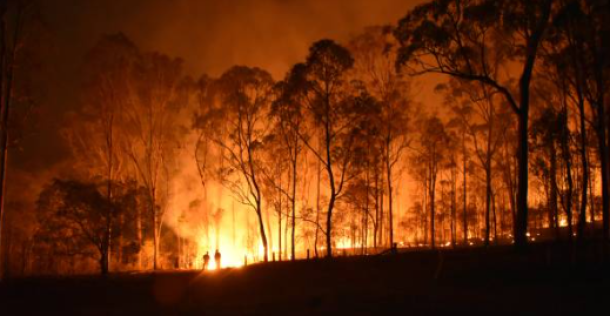
The problem was that he already drank all but 16 ounces of his water and only had a couple of mangos and oranges left. Fearing that his meager rations might not be enough to sustain him for another day, he made the fateful decision to set a signal fire hoping the smoke would attract help (even though, at 9:30 at night, it was dark). Powers determined that using a firepit near the cabin would not ....