
- Ref # CAE00002
- November 22, 2020
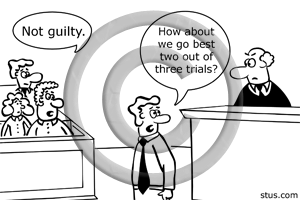
Fifth Amendment Double Jeopardy
It’s a long-standing rule that the Double Jeopardy Clause of the Fifth Amendment does not prevent separate jurisdictions (i.e., federal and state) from prosecuting a defendant for the same offense that is in violation of the laws of both jurisdictions. (See, for instance, Abbate v. United States (1959) 359 U.S. 187.) The continuing validity of this “dual-sovereignty exception” to the Double Jeopardy rule was just reaffirmed by the U.S. Supreme Court in a seven-to-two decision in Gamble v. United States (June 17, 2019) __ U.S. __ [2019 U.S. LEXIS 4173; 2019 WL 2493923]. Defendant Gamble pled guilty in Alabama to a state violation of possessing a firearm as a felon. Apparently unsatisfied, the feds followed up Gamble’s state conviction by indicting him with the federal version of the same offense. Gamble complained that the Double Jeopardy Clause should prevent the U.S. Government from also prosecuting him for the possession of the same gun under the same circumstances. The Supreme Court ruled against him, holding that a crime under one sovereign’s laws is not “the same offense” as a crime under the laws of another sovereign, and under the dual-sovereignty doctrine, both jurisdictions get a shot at him. The U.S. Supreme Court in Gamble thus declined to overrule this long-standing interpretation of the Double Jeopardy Clause. But note that that being said, the defendant-friendly California Legislature doesn’t like that rule, at least where the federal government takes its shot at the defendant first, so they legislated it away. The rule in California is that although the federal government can prosecute someone already prosecuted in California’s Courts (whether convicted or acquitted; Can you say “Rodney King ”), California is prevented by statute from prosecuting someone already tried in federal court. Under Penal Code §§ 654 & 1023, an offense already prosecuted by another entity (e.g., federally) is not also punishable under California state law. (See People v. Tideman (1962) 57 Cal.2 nd 574, for a discussion on double jeopardy principles as interpreted under California law.)
© 2026 Legal Updates, LLC.
This content is protected by copyright law. Republishing or redistribution in any form without written permission is strictly prohibited. For licensing or reprint requests, contact support@legalupdates.com.