
- Ref # CAB10155
- July 30, 2026
Driverless Cars: You’ll Be Seeing More of Them; But How Do You Conduct a Traffic Stop or Handle an Emergency?
Citing and Control of Autonomous Vehicles
By Robert Phillips
Deputy District Attorney (ret.)
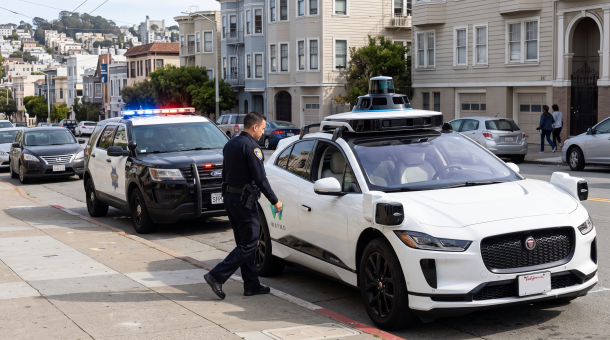
The question may have occurred to you: What is a law enforcement officer to do when a so-called “autonomous (driverless) vehicle” is observed committing a traffic infraction?
If you just flip on your emergency lights and maybe hit it with a short burst from your siren, can you expect the vehicle to pull over? If you somehow get the vehicle stopped, who do you ask for a license, registration and proof of insurance? And then who, if anybody, do you arrest when no such documentation is provided? Are the passengers — who may be wondering what the hell is going on — responsible for the vehicle’s violations?
Fortunately, California’s legislators have prepared for just such a dilemma. As of July 1, 2026, new Vehicle Code § 38751 became effective. Pursuant to this new statutory provision, officers observing an autonomous vehicle violate a traffic offense (or in any other unusual circumstance) can go right to the source: the “manufacturer operating an autonomous vehicle.”
This statute requires the manufacturer to “maintain a dedicated emergency response telephone line that is available for emergency response officials during all hours when an autonomous vehicle is on a public road.” (Veh. Code § 38751(b)(1)(A)) An “emergency response official” is defined as including but not limited to “emergency dispatchers, peace officers as defined in Penal Code §§ 830 et. seq. and first responders” such as firefighters. (Subd. (a)(2))
An “emergency” is defined in this new legislation of meaning “a sudden, unexpected occurrence demanding immediate action to prevent or mitigate loss or damage to life, health, property, or essential public services.” (Subd. (a)(3))
The legislature provided that a manufacturer of an autonomous vehicle “shall continuously monitor the status of each autonomous vehicle on a public road and shall equip and staff the telephone line to ensure that calls are picked up within 30 seconds by a remote human operator who has situational awareness of all autonomous vehicles on public roads.” (Subd. (b)(1)(B))
Then, to ensure immediate action is taken: the “remote ....
© 2026 Legal Updates, LLC.
This content is protected by copyright law. Republishing or redistribution in any form without written permission is strictly prohibited. For licensing or reprint requests, contact support@legalupdates.com.