- Ref # CAC00025
- March 22, 2021
Miranda Violations and Civil Liability
- Miranda and the Fifth Amendment
- Civil Liability for Intentional Miranda Violations
When an incriminating statement obtained during a custodial interrogation in violation of Miranda is used against a defendant in the prosecution’s case-in-chief, the defendant’s constitutional Fifth Amendment right against self-incrimination is violated. Such a violation, even if not involving coercive interrogation techniques, may serve as a basis for a federal 42 U.S.C. § 1983 civil suit for which the offending officer is responsible.
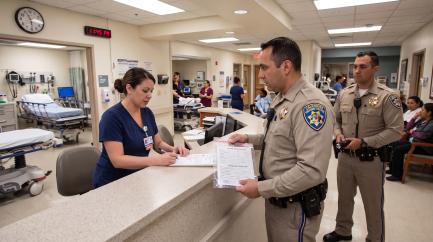
Plaintiff Terence Tekoh worked at a Los Angeles medical center, his job being to move patients between their hospital rooms and the MRI section. On one such occasion, he was accused by a female patient of having lifted her cover sheets and touching her vaginal area. Hospital staff reported the allegation to the Los Angeles Sheriff’s Department. Deputy Carlos Vega responded to investigate. In contacting plaintiff, Deputy Vega asked if there was somewhere private that they could talk. It was suggested that they use the MRI “reading room;” a small, windowless, and soundproof room used by doctors to read MRIs. They were later joined by Deputy Vega’s supervisor, Sgt. Strangeland. What happened in that room before Sgt. Strangelove’s arrival became the point of contention. Per Deputy Vega, plaintiff immediately admitted that he had “made a mistake.” Asked to write on paper what had occurred, plaintiff put in writing what he himself referred to as an “honest and regrettable apology,” admitting in a brief account to “spreading (the patient’s) vagina lip for a quick view.” Sgt. Strangeland arrived afterwards, somewhat corroborating Deputy Vega’s account when he later testified that by the time he got there, plaintiff’s “demeanor (appeared to be) ‘that of a man who was contrite, who truly . . . regretted what he had done.’” Plaintiff, on the ....